
Victoria-Idongesit Udondian, Interdisciplinary Artist
My work is driven by my interest in textiles and the potential for clothing to shape identity, informed by histories and tacit meanings embedded in everyday materials and objects. With training in tailoring, painting, sculpture and new genres, I create large-scale sculptural elements and interdisciplinary projects that examine the intersection of identity, migration, labour, and global trade systems, raising questions about our postcolonial condition. I work across textiles, sculpture, installation, performance, photography, video, and most recently ceramics, integrating contemporary art making sensibility with various traditional techniques such as weaving, ‘threading’, sewing, dyeing, and sometimes digital media, rooted in my cultural history and learned naturally while growing up in Nigeria.
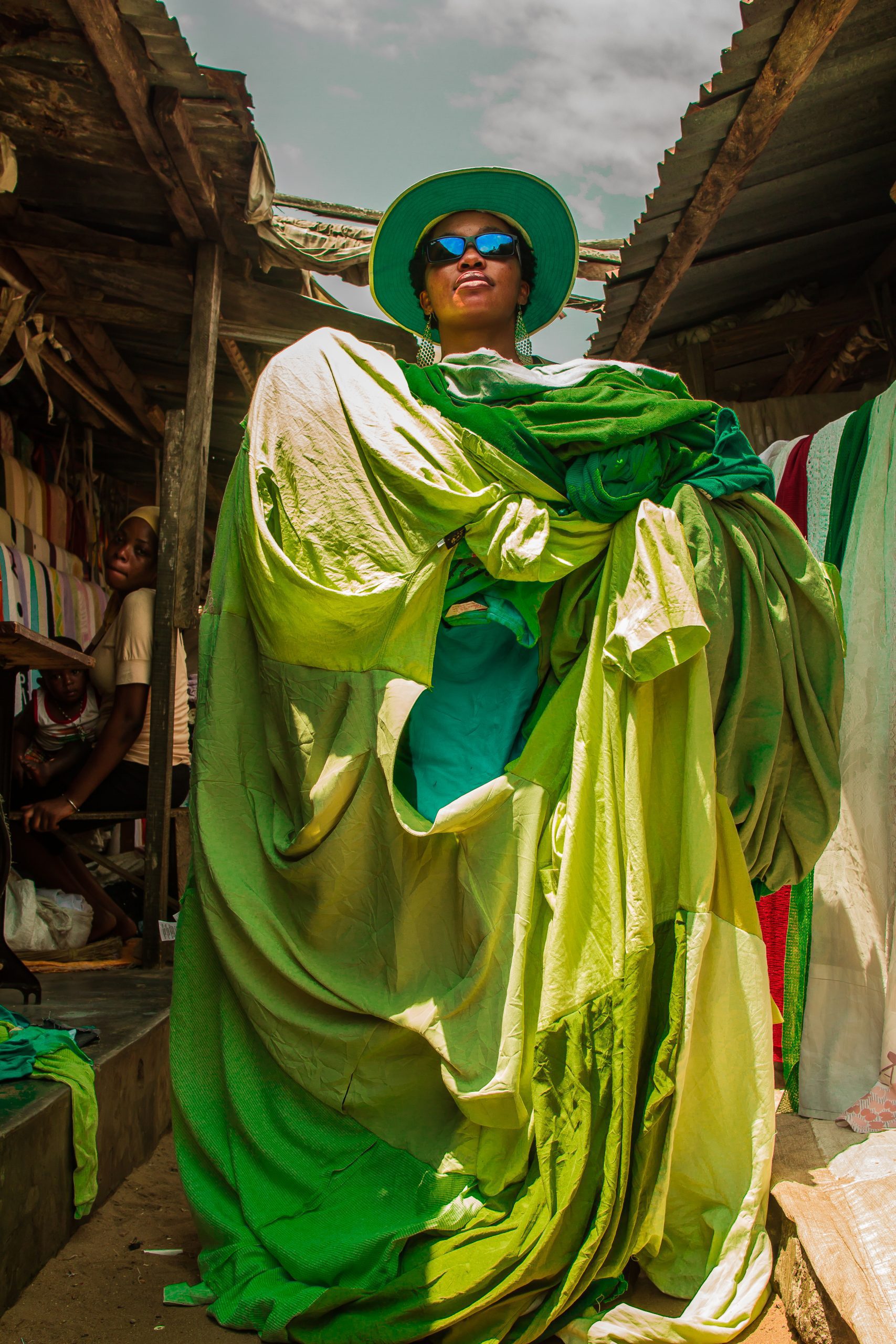
For more than a decade, my work has questioned the complex dynamics of the second-hand clothing market, particularly in Africa, where the continent has become a dumping ground for various forms of waste from the West. I began to explore, using the second-hand clothing industry as a starting point. I question how cast-off clothing and local consumption of foreign-made goods impact our cultural identity as well as our environment. I am interested in the materiality as well as the historicity of second-hand materials with which I work: travelling the world from the West to the Global South, carrying the personal and social histories of the people involved in this economy, and how those histories begin to be complicated when others acquire the clothing and wear them. These second-hand materials have become power objects in my work, transformed into large-scale textile sculptures, costumes or hybrid garments that weave traditional Nigerian and Western myths and narratives together. These costumes and sculptural forms are activated by bodies through still photos or performances.
Beyond the tactile tangibility of my work, some of my projects take on different forms. Given my interest in shapeshifting, I have begun exploring exhibition-wide conceits in which, for example, I limit viewers’ access to a gallery via a simulated immigration interview or produce and exhibit works by my alter egos or fictional Nigerian artists or through collaborations with immigrant communities where I live, or present my works with an accompanying fictional historical context, in the form of a written narrative, a label. The text tells a historically plausible narrative, placing my work alongside a retelling of facts about Nigerian weaving, the patterns of the European clothing trade, anthropology, and colonialism, involving notions of provenance, origin and historical fact. I am interested in how these strategies change how viewers interpret the objects they encounter, or in some cases, do not encounter. In traversing gallery spaces, who has access to which materials? When and under what circumstances? Controlled by whom and to whose benefit? Neither the conceptual framework nor the physical works seek to resolve these questions, but rather point to how we construct our identities and how they determine our interactions with one another and our surroundings.